July 15, 2026
Third giant planet discovered in the Beta Pictoris system
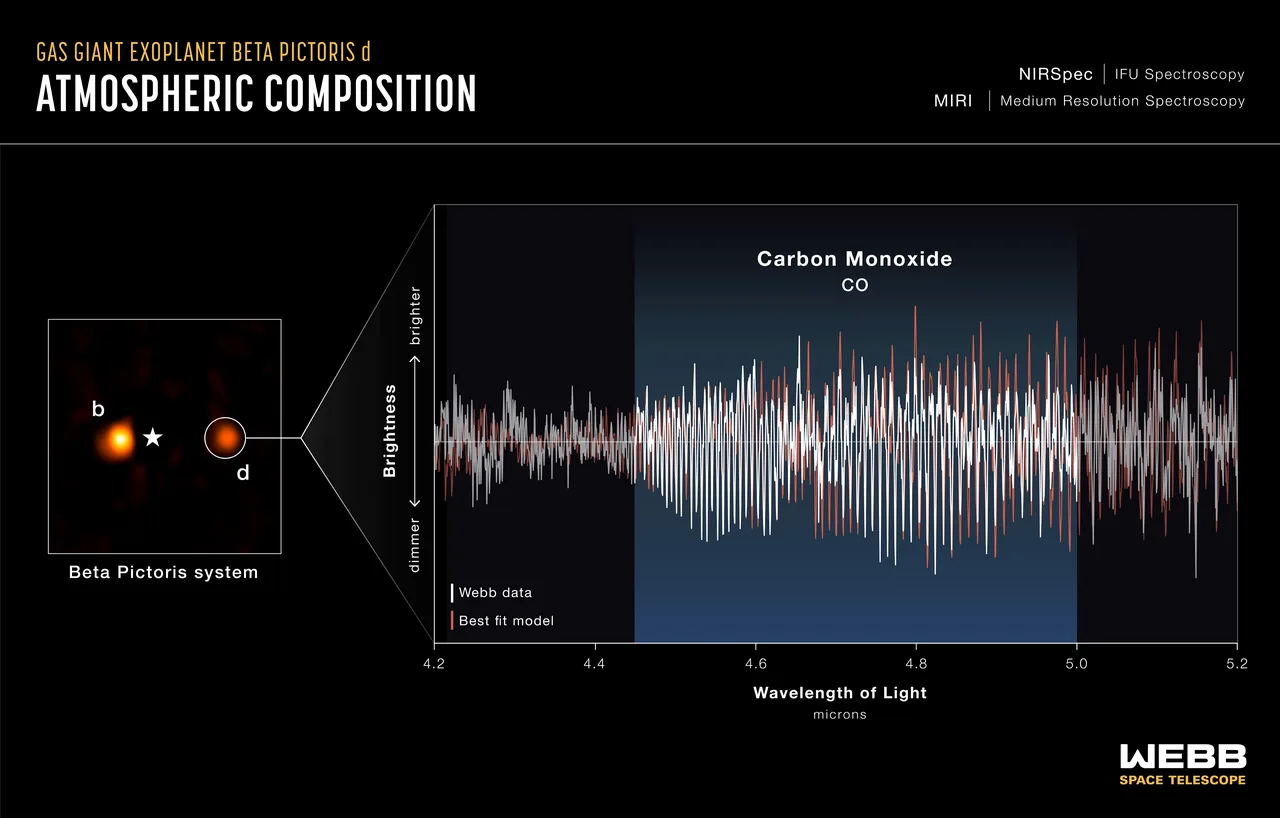
The Beta Pictoris system, about 63 light-years away, is one of the best-studied young planetary systems. Two gas giants, Beta Pictoris b and c, were already known there. In July 2026, two teams independently reported a third planet. One team used the NIRSpec spectrograph of the James Webb Space Telescope and was able to distinguish the planet from background sources by the chemical signature of carbon monoxide in its atmosphere. A second team imaged it directly with the ERIS instrument at ESO's Very Large Telescope and subsequently also found it in archival images up to eleven years old.
Beta Pictoris d is about 2.4 times as massive as Jupiter, orbits its star at a distance of roughly 26 AU and is about a hundred times fainter than Beta Pictoris b. This makes the system only the second one known with at least three directly imaged planets.
Sources: NASA: "NASA's Webb Discovers Hidden Planet in Famous Star System." Online; science.nasa.gov; 2026-07-15; ESO: "Faintest planet ever imaged from Earth found after more than 10 years of hide-and-seek." Online; eso.org; 2026-07-15