The Brazil Nut Effect
Open a bag of mixed nuts and the largest ones, usually the Brazil nuts, are on top. Open a box of muesli and the big clusters sit above the fine oats. The same thing happens in a jar of pebbles and sand after a few shakes: the pebbles rise. This is surprising, because the large pieces are often the heaviest and one would expect them to sink. The phenomenon is known as the Brazil nut effect, and it has kept granular physicists busy for several decades.
Void filling
The first explanation came from a computer simulation. Rosato and colleagues shook a mixture of large and small discs and watched the large ones climb. Their reasoning: every shake lifts the whole bed for a moment and opens small gaps between the particles. Small grains can fall into any gap that opens below them; a large particle needs a gap of its own size, which almost never appears. So small grains trickle downwards, step by step, and the large particle is left sitting a little higher after every shake. It never moves up by itself; the bed simply disappears from under it.
Convection
Void filling is real, but it is slow and does not explain everything. Knight, Jaeger and Nagel followed individual particles in a shaken cylinder and found a second, much faster mechanism. Friction against the walls holds back the grains next to them, so each shake sets up a convection roll: the material rises in the centre of the container and sinks in a thin layer along the walls. A large particle is carried up with the central flow. At the surface it is pushed outward, but it does not fit into the narrow downward stream at the wall, so it stays on top while the small grains continue to circulate.
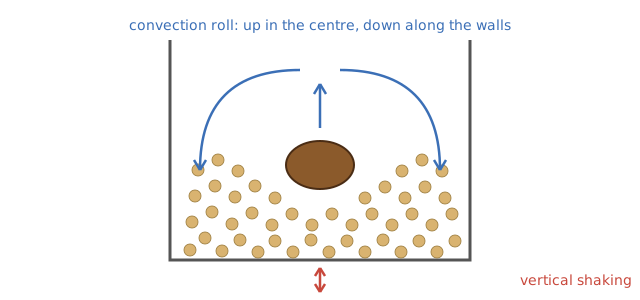
Convection roll in a shaken container: the material rises in the centre and sinks along the walls.
The two mechanisms can be told apart in experiments. If the walls are made smooth, or the container widens towards the top, convection weakens and the large particle rises much more slowly.
The role of air
For a long time the effect was treated as a problem of grains alone. Möbius and colleagues then showed that the air between the grains matters as much as the grains themselves. In their experiments the rise time of a large sphere depended strongly on its density and on the air pressure in the container. At reduced pressure the behaviour changed qualitatively, and under some conditions a light particle sank while a heavy one rose, the opposite of what intuition and the earlier models predicted. Air flowing through the bed during each shake drags on the grains and can either help or hinder the segregation.
The practical side is anything but academic. Pharmaceutical powders, cereals, fertiliser, construction aggregates and ore all segregate by size during transport and pouring, and a tablet pressed from a poorly mixed powder contains the wrong dose. Much of what is known about the Brazil nut effect was learnt in order to prevent it.
References
- A. Rosato, K. J. Strandburg, F. Prinz, R. H. Swendsen: Why the Brazil nuts are on top: Size segregation of particulate matter by shaking. Physical Review Letters 58, 1038–1040 (1987)
- J. B. Knight, H. M. Jaeger, S. R. Nagel: Vibration-induced size separation in granular media: The convection connection. Physical Review Letters 70, 3728–3731 (1993)
- M. E. Möbius, B. E. Lauderdale, S. R. Nagel, H. M. Jaeger: Size separation of granular particles. Nature 414, 270 (2001)