The Coffee Ring Effect
Spill a drop of coffee on a table and let it dry. What remains is not an evenly tinted spot but a pale disc with a sharp, dark rim. Almost all of the coffee particles have gathered at the edge. The same happens with red wine, tea, ink or a drop of muddy water. The phenomenon is known as the coffee ring effect, and its explanation was only published in 1997.
Why the particles move to the edge
Intuitively one might expect the particles to settle wherever they happen to be when the water disappears. Robert Deegan and his colleagues at the University of Chicago showed that this is not the case. Their explanation in the journal Nature rests on two observations:
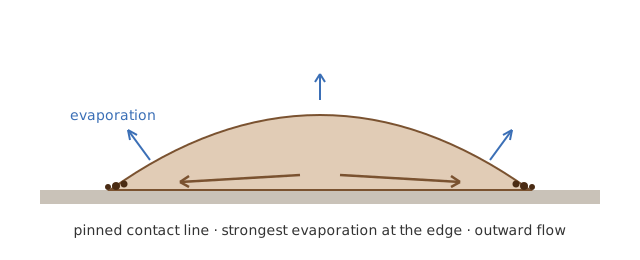
- The edge of the drop is pinned. Small irregularities of the surface hold the contact line in place. The drop cannot shrink in diameter while it dries; it can only become flatter.
- Evaporation is strongest at the edge. Water molecules near the rim can escape into a larger volume of surrounding air than those at the top of the drop.
Because the drop keeps its footprint while it loses most water near the rim, liquid must flow from the centre towards the edge to replace what has evaporated. This outward capillary flow carries the suspended particles along and deposits them at the contact line. Within minutes, almost all of the solid material ends up in a thin ring.
When the ring does not form
The ring is not inevitable. Differences in temperature or composition along the surface of the drop create gradients in surface tension, which drive a flow along the surface, the Marangoni flow. If it is strong enough, it pulls particles back towards the centre. Hu and Larson showed in 2006 that suppressing or enhancing this flow decides whether a ring or a central spot remains.
The shape of the particles matters as well. Yunker and colleagues reported in 2011 that elongated, ellipsoidal particles deform the surface of the drop so strongly that they lock into a loosely packed network at the surface. Instead of a ring, they leave a nearly uniform deposit. A tiny fraction of such particles is enough to suppress the effect.
Why anyone cares
What is a nuisance on a coffee table is a real problem in technology. Inkjet printers, printed electronics, the coating of surfaces and the spotting of DNA microarrays all rely on drops of liquid that leave behind an even layer of material. A ring-shaped deposit means uneven conductivity, uneven colour or unreliable measurements. Conversely, the effect can be put to use: it concentrates material at a well-defined line, which has been exploited for simple diagnostic tests and for the controlled deposition of nanoparticles.
References
- R. D. Deegan, O. Bakajin, T. F. Dupont, G. Huber, S. R. Nagel, T. A. Witten: Capillary flow as the cause of ring stains from dried liquid drops. Nature 389, 827–829 (1997)
- H. Hu, R. G. Larson: Marangoni effect reverses coffee-ring depositions. Journal of Physical Chemistry B 110, 7090–7094 (2006)
- P. J. Yunker, T. Still, M. A. Lohr, A. G. Yodh: Suppression of the coffee-ring effect by shape-dependent capillary interactions. Nature 476, 308–311 (2011)