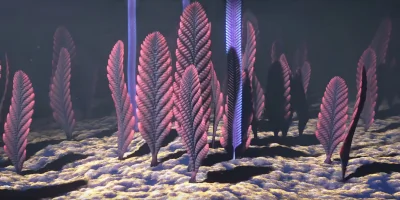
Visit the miraculous world of pre cambrian life forms. The Ediacara biota is a group of mostly soft-bodied organisms that lived during the Ediacaran period 635-538 million years ago.

How the tides lengthen our days and what lies ahead for Earth and the Moon
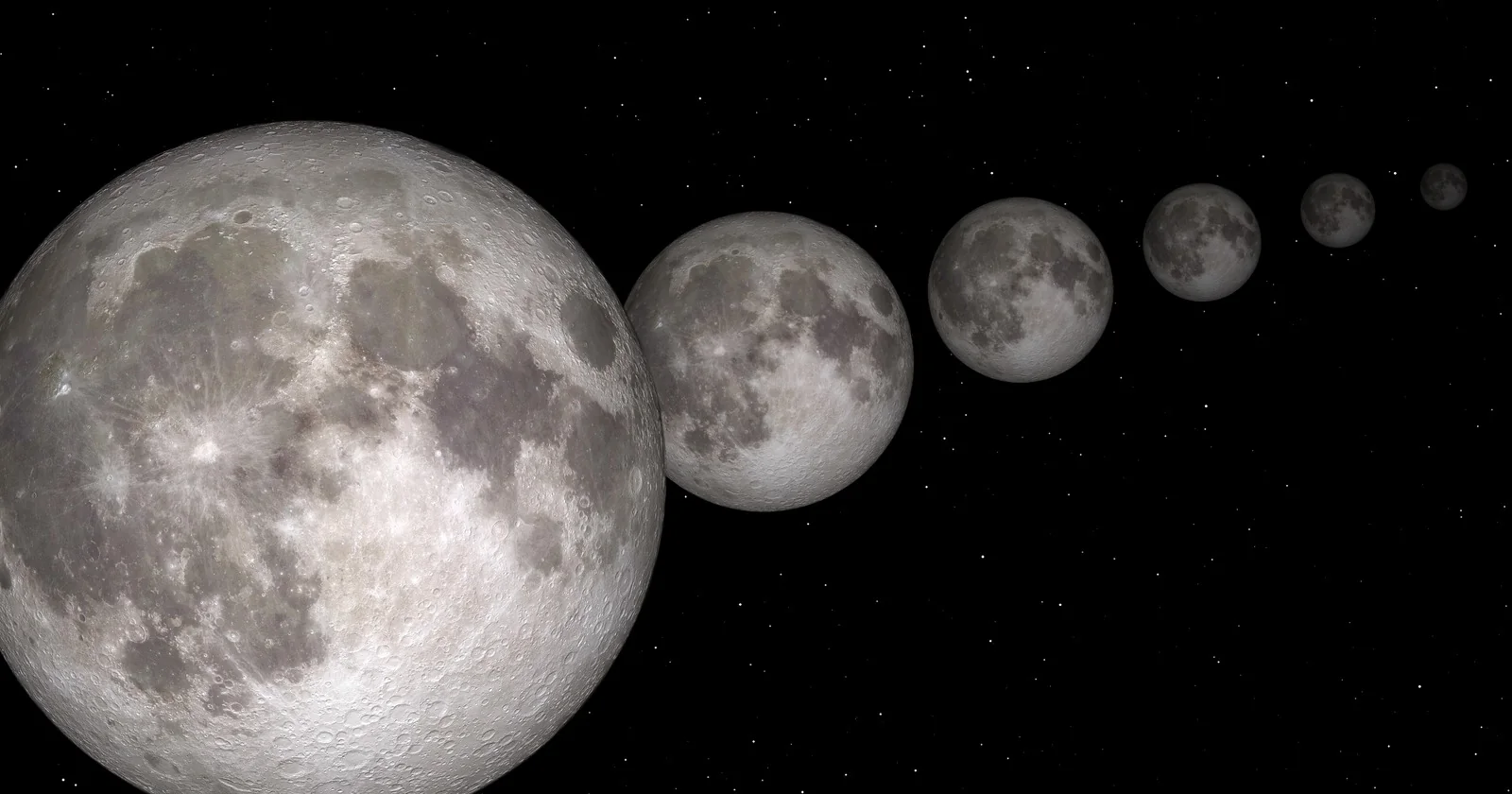 The Moon is moving away from Earth at about 3.8 centimeters a year. Image adapted from “Full Moon” by NASA’s
Goddard Space Flight Center.
Original image on Wikimedia
Commons (public domain).
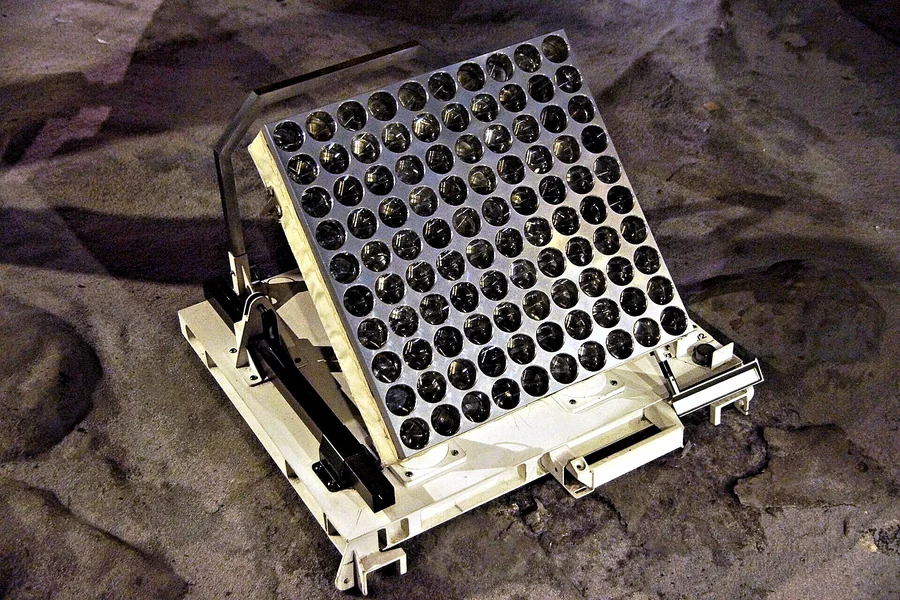 Replica of the Apollo 11 laser reflector at the Science Museum in London. Photo by Tohma,
via
Wikimedia Commons (CC BY-SA 4.0).
On July 21, 1969, Buzz Aldrin set a rather unassuming instrument down in the lunar dust at the Sea of Tranquility. It held a hundred fused-silica prisms called retroreflectors. Of all the experiments Apollo 11 left on the Moon, this is the only one still working today.
A retroreflector sends light back the way it came. For more than half a century, observatories have aimed laser pulses at the Apollo 11 array and the handful of reflectors that came after it. Timing the round trip lets astronomers measure the distance from Earth to the Moon to within a few millimeters.
Those measurements tell us that the Moon is moving away from Earth at 3.8 centimeters a year. [1], [2] That’s about as fast as your fingernails grow. But Earth is 4.5 billion years old, and over that kind of time, slow and steady wins. If Earth and the Moon had a relationship status, it would be “It’s complicated.” The Moon needs a little space. It might even tell Earth, “It’s not you, it’s me.” As we’ll see, they both have a hand in it.
An ordinary mirror would be little use here. To send light back to the telescope, its surface would have to be exactly perpendicular to the incoming beam. Tilt a mirror on the Moon by just one thousandth of a degree and the reflected beam would miss the telescope by more than 13 kilometers. A retroreflector is much more forgiving. Inside each prism, light bounces off three faces set at right angles to one another. Together, those reflections reverse the beam’s direction even when the prism is tilted.
A laser pulse leaves the telescope carrying roughly a quintillion photons. By the time it reaches the Moon, the beam is several kilometers wide. The reflector is barely bigger than a briefcase, and the light it sends back spreads out again on the return trip. At most stations, the average number of photons detected per pulse is less than one.
The trick is to pick out those few photons and time their roughly two-and-a-half-second round trip to within a fraction of a nanosecond. A laser coupled to a telescope fires pulse after pulse. A filter admits only a narrow band of light around the laser’s wavelength. [17] The best conditions are at night, when there is no sunlight scattering in Earth’s atmosphere, and ideally when the ground around the reflector is in shadow too. Ranging is possible in moonlight and, with infrared lasers, even in daylight. In both cases, stray light makes the returning photons harder to pick out.
Five of the reflectors on the Moon date from the early days of space exploration. The crews of Apollo 11, 14 and 15 set up three of them. The other two rode aboard the Soviet Lunokhod 1 and 2 rovers. [2] An analysis of measurements dating back to 1970 puts the annual increase in the semimajor axis of the Moon’s orbit at 38.30 ± 0.08 millimeters. [1]
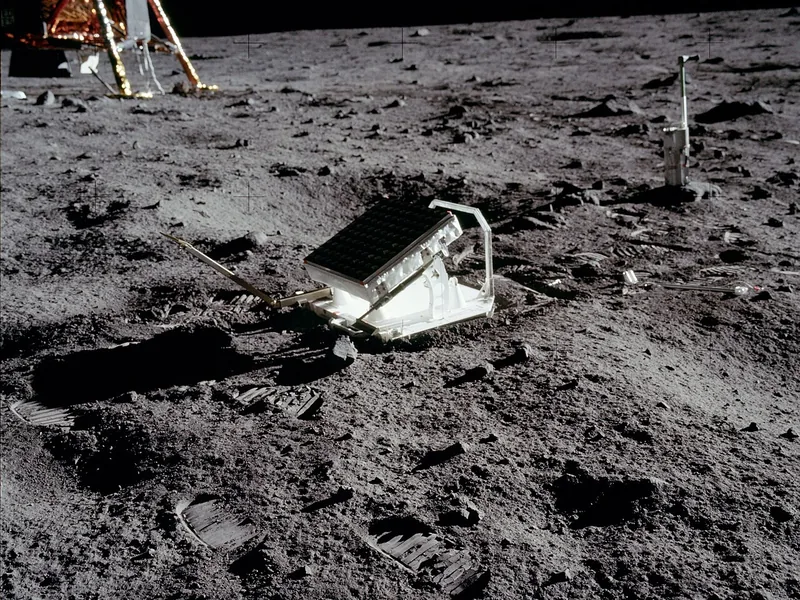 The Apollo 11 laser reflector in the Sea of Tranquility, photographed on July 21, 1969. Detail from NASA
photograph AS11-40-5952,
via Wikimedia
Commons (public domain).
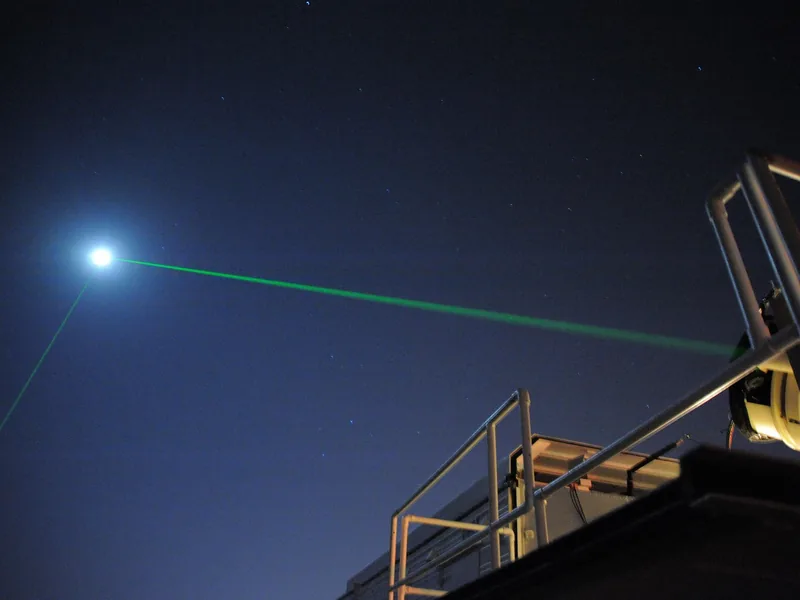 Two laser beams aimed at the Lunar Reconnaissance Orbiter. One comes from NASA’s Goddard Space Flight Center.
The other comes from a second ground station tracking the same spacecraft. Photo by NASA,
via
Wikimedia Commons (public domain).
Something is giving the Moon a slow but steady push. Where does the energy come from? Conservation of energy applies in the solar system just as it does everywhere else.
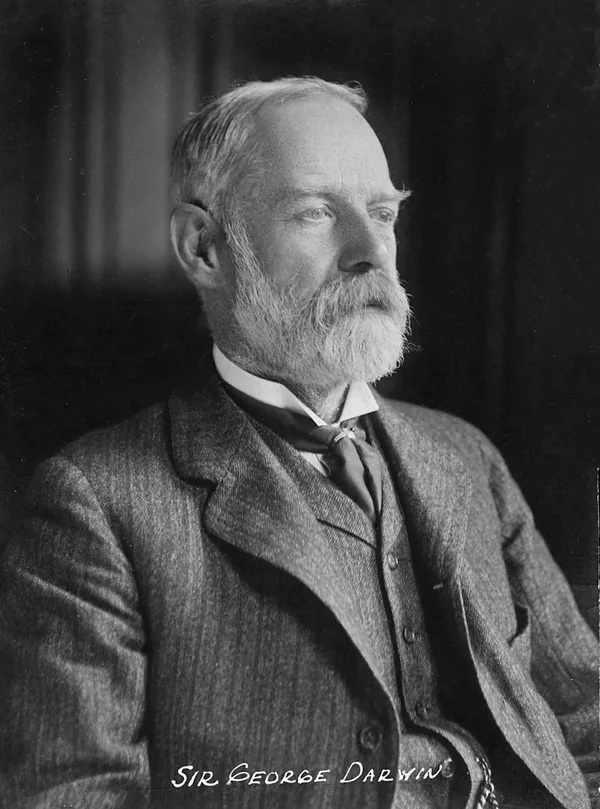 George Howard Darwin (1845–1912), son of Charles Darwin, photographed around 1906. Photo by J. Russell &
Sons, via Wikimedia Commons
(public domain).
Edmond Halley was the first to spot something amiss with the Moon’s motion. In the late 17th century he compared ancient eclipse records with the lunar tables of his day. The dates didn’t line up. Halley suspected that the Moon was moving around Earth faster than it had in antiquity. He offered no figures. An English astronomer, Richard Dunthorne, supplied those in 1749. [4]
In 1754 the Berlin Academy of Sciences offered a prize for answering a question. Had Earth’s rotation changed since the planet formed? A thirty-year-old tutor in Königsberg decided against entering the competition and wrote an essay for the local weekly instead. He argued that the endless ebb and flow of the tides must gradually slow Earth’s spin. The tutor was Immanuel Kant. His essay [5] attracted little attention for years.
Halley and Kant had seen the same phenomenon from different sides. The apparent speedup of the Moon was a clue that the clock Halley had measured it against, Earth’s rotation, was losing time. The full theory came later, from George Howard Darwin, the second son of Charles Darwin.
While his father made his name with the theory of evolution, George became an astronomer at Cambridge. Beginning in 1878, he worked out what tidal friction does to a planet and its moon over long stretches of time and published his results in a series of papers for the Royal Society. He traced Earth and the Moon back to a time when the Moon orbited close above a rapidly spinning Earth, then forward to a future in which both the day and the lunar month grow longer. [6]
Darwin concluded that the Moon had once broken away from Earth. He was partly right about its origins, though the mechanism he proposed was wide of the mark. He thought that tides raised by the Sun had driven the young Earth into resonance and flung off the material that became the Moon. The leading explanation today involves a far more violent event. About 4.5 billion years ago, a body the size of Mars struck the young Earth. The Moon formed from the debris. [7] We call that body Theia, after the Titan who gave birth to the Sun and the Moon in Greek mythology.
The heart of Darwin’s argument has stood up well. The Moon was once much closer, and a day on the young Earth lasted only about five hours. [8]
Tides arise because gravity weakens with distance. The Moon pulls harder on the side of Earth facing it than it does on Earth’s center, and more weakly on the far side. These differences deform the solid Earth as well as its oceans. Earth raises tides on the Moon in much the same way.
Earth and the Moon are both spinning bodies of rock thousands of kilometers across. Earth turns once on its axis in just under 24 hours, while the Moon takes a little over 27 days to complete an orbit. As Earth turns, the rock in its mantle flexes under the Moon’s pull and springs back almost elastically. Internal friction introduces a slight delay. By the time the deformation at any one spot reaches its peak, Earth has turned a little farther beneath the Moon. The tidal bulge on the near side therefore sits slightly ahead of the Moon in the direction Earth rotates.
The gravity of the displaced tidal bulges pulls the Moon forward along its orbit. In turn, the Moon’s pull on the bulges slows Earth’s spin. This transfers angular momentum from Earth’s rotation to the Moon’s orbit. The Moon gradually moves farther away. In that wider orbit its average speed is lower and each trip around Earth takes longer. Some of the energy Earth loses from its spin goes into the Moon’s orbit. Tidal friction turns the rest into heat.
The simulation below models Earth as 197 point masses linked by springs and dampers. Gravity deforms this model Earth, and you can watch tidal friction change both its spin and the Moon’s orbit.
Use the buttons at the bottom right to position the camera and choose whether it rotates. To make tidal friction visible in the model, the Moon is much too massive and too close to Earth, and Earth is much too soft. The drawing exaggerates Earth’s deformation by a further factor of 15. On the real Earth, most tidal braking takes place in the oceans. Source code. Earth imagery adapted at reduced resolution from “The Blue Marble” by NASA’s Goddard Space Flight Center, via Wikimedia Commons (CC BY-SA 3.0).Place the camera above Earth and set it to rotate with the Earth–Moon system. You’ll see the familiar textbook view. The Moon holds still, Earth turns beneath the tidal bulge, and the bulge points just ahead of the Moon that raised it. Now use the slider to make a day longer than the Moon’s orbital period. The bulge falls behind, Earth spins faster, and the Moon spirals inward. This is what is happening to Phobos. It orbits Mars faster than Mars turns on its axis. It is spiraling toward the planet and will eventually fall back to it.
Orbital mechanics has a surprise in store. Pull the Moon forward and it ends up moving more slowly. The push lifts it into a wider orbit, where it travels at a lower speed and takes longer to get around. The energy budget is just as surprising. Only about one thirtieth of the energy lost from Earth’s rotation makes it into the Moon’s orbit. The reason lies in the relative rates of the two motions. Earth turns a little over 27 times for every trip the Moon makes around it. Most of the energy ends up as heat. The deep ocean alone dissipates about a terawatt, somewhere between a quarter and a third of the total. [3] Turn on the energy display in the simulation to see the heat build up along the yellow curve.
How can we check any of this? Laser measurements go back to 1969, and reliable eclipse records stretch back nearly 3,000 years. For anything earlier, we need a clock that left a mark in the geological record. There are several to choose from.
For thousands of years, Babylonian, Chinese, Greek and Arab observers recorded when and where they saw solar and lunar eclipses. Work backward on the assumption that Earth has always spun at the same rate, and the eclipses turn up in the wrong places. The predicted shadow can fall thousands of kilometers from the city whose observers actually saw the solar eclipse. Earth must once have spun faster. Taken together, 2,700 years of observations show that the day has lengthened by an average of 1.8 milliseconds per century. [9]
Tidal friction alone would give us about 2.3 milliseconds per century. Part of the difference comes from the way Earth is still changing shape in the wake of the last ice age. Like a figure skater drawing in her arms, it spins a little faster as its mass shifts inward. Two milliseconds per century sounds negligible. Yet over 27 centuries, a clock ticking at a perfectly steady rate would drift several hours out of step with Earth’s rotation.
Fossil corals take us much further back. Some corals build their limestone skeletons one fine layer a day. The thickness of those layers varies with the seasons, leaving annual bands rather like tree rings. In 1963 the American paleontologist John W. Wells had the idea of counting the daily layers within the annual bands of Devonian corals. Where you might expect 365, he found an average of 400. [10]
A Devonian year lasted about as long as a year does now. Earth still takes much the same time to go around the Sun. More days fit into a year then because each day lasted about 22 hours.
Tidal rhythmites take the story back to a time before corals. In estuaries and bays, a rising tide can lay down a thin layer of sand or mud. Spring tides leave thicker layers, neap tides thinner ones. Counting the layers and measuring their thickness reveals how many days there were in a lunar month and how many months there were in a year.
Some of the best-known rhythmites come from South Australia and are about 620 million years old. They formed toward the end of the great Precambrian ice ages, tens of millions of years before the large organisms of the Ediacaran biota colonized the seafloor. Australian geologist George Williams read a year of 13.1 lunar months and roughly 400 days in those rocks. A day lasted 21.9 hours, and the Moon was about 3.5 percent closer than it is today. [11] These geological clocks all tell the same story. The further back we look, the shorter the day and the closer the Moon. George Darwin had it right.
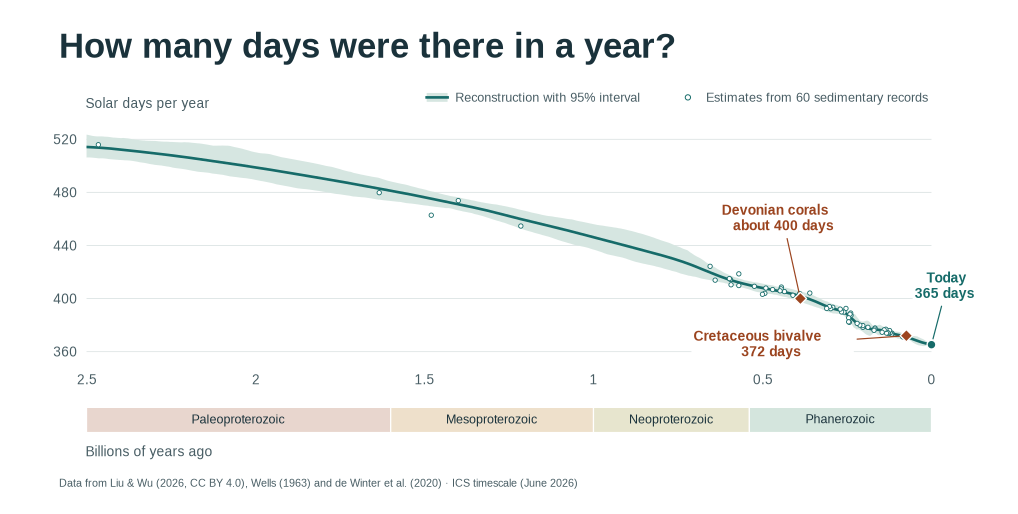 The circles are estimates from 60 sedimentary records. The green curve is a reconstruction based on those
estimates. The two diamonds give independent counts of the days in a year, taken from growth bands in Devonian
corals and a Cretaceous bivalve. [10], [18] The
data from Liu and Wu (CC BY
4.0) have been converted to solar days per year.
The Moon can drift only so far under the influence of tides. Its orbit would eventually reach a semimajor axis of about 550,000 kilometers. At that point the two bodies would be tidally locked to each other. A day on Earth and an orbit of the Moon would each last about 47 present-day Earth days. Getting there would take some 50 billion years. Long before then, the Sun will have become a white dwarf, and Earth and the Moon will either have been destroyed or changed beyond recognition.
Even optimistic estimates give Earth’s biosphere only another billion years or so. The last survivors are likely to be single-celled organisms. They would have a Moon about 415,000 kilometers away, orbiting once every 31.5 days. By astronomical standards, that’s much like the Moon we know.
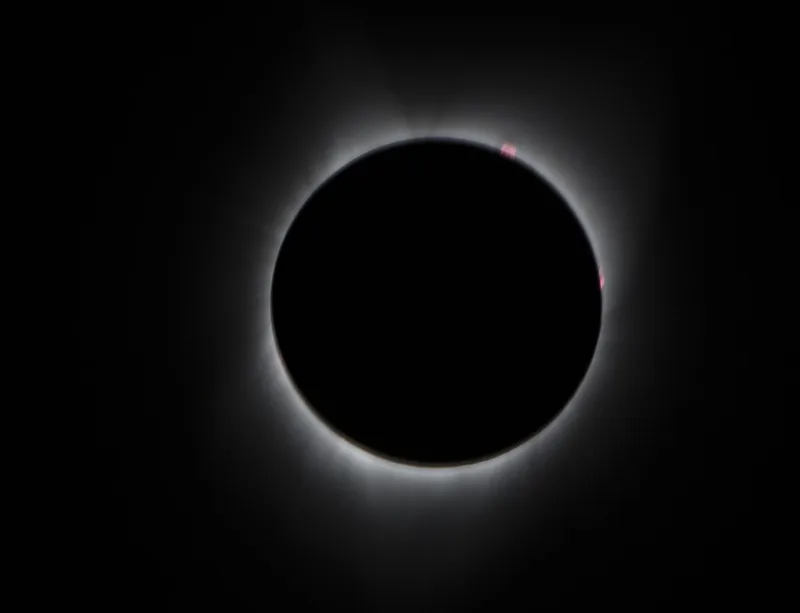 The total solar eclipse of August 21, 2017, photographed from a NASA research aircraft over the United States.
The Moon just covers the Sun’s bright disk, revealing the corona. Detail from a photograph by NASA/Carla Thomas,
via Wikimedia
Commons (public domain).
The Sun is about 400 times as wide as the Moon and about 400 times as far away. The two disks therefore look almost exactly the same size in our sky. That extraordinary coincidence gives us total solar eclipses. For a few minutes the Moon covers the Sun’s bright face so precisely that we can see the corona and eruptions at the Sun’s edge. You could almost imagine the universe had arranged it just for the view.
The coincidence has an expiration date. Even today, when the Moon is near the far end of its orbit, it can look too small to cover the Sun. At mid-eclipse a bright ring remains. With every centimeter the Moon recedes, total eclipses gradually become rarer and shorter. In about 650 million years, even the closest approach in the Moon’s orbit will no longer bring it near enough to cover the Sun completely. [13]
In just under 200 million years, a day will last roughly 25 hours. That change should matter little to life on Earth. Organisms have adapted to changing day lengths many times before.
One of the most important things the Moon does for Earth is also one of the least obvious. Earth’s axis is tilted about 23.5 degrees from the perpendicular to its orbit, and that tilt has been fairly stable. The Moon helps keep it that way. Its gravity makes Earth’s axis precess, much like the axis of a spinning top, fast enough to keep gravitational tugs from other planets from throwing it off balance.
In 1993 the French astronomer Jacques Laskar and his colleagues calculated what might happen without the Moon. Earth’s tilt could become chaotic, swinging between nearly zero and 85 degrees. [14] On a planet tipped that far over, the poles can receive more sunlight over the course of a year than the equator, and the seasons would be unlike anything we know. Mars, with only two tiny moons, faces just this problem.
As the Moon recedes, its stabilizing influence weakens. Laskar’s group calculated that Earth’s axis could enter this chaotic regime between 1.5 and 4.5 billion years from now. In just over two thirds of the cases they modeled, the tilt eventually exceeded 80 degrees. [15]
Visit the miraculous world of pre cambrian life forms. The Ediacara biota is a group of mostly soft-bodied organisms that lived during the Ediacaran period 635-538 million years ago.
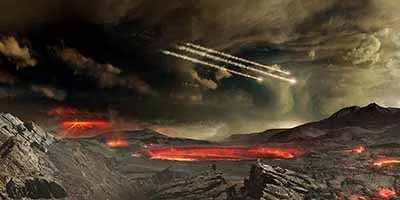
The story of the first 3.5 billion years of life on Earth. From chemical evolution through prokaryotes and photosynthesis to the first multicellular life forms.

Of Moon and Mars civilizations. About the historical beginnings of the search for life in space.

Where is the second Earth? About the methods and the current state of exoplanet discovery.