Where is the second Earth? About the methods and the current state of exoplanet discovery.

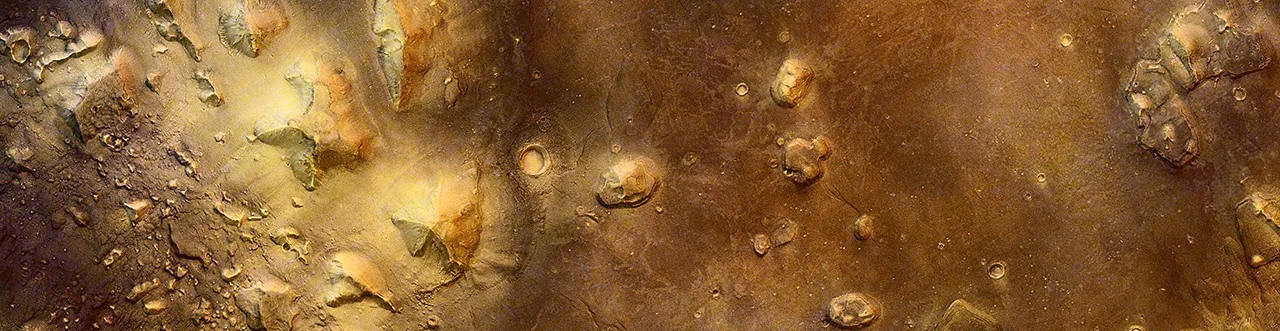 The Cydonia region of Mars with the "Face on Mars", imaged by ESA's Mars Express spacecraft. (Source: ESA/DLR/FU Berlin, G. Neukum, CC BY-SA IGO 3.0)
The search for life beyond Earth is a driving force in the exploration of the universe. Probably everyone who, knowing about the nature of the stars, has looked at the Milky Way on a clear night has wondered whether we are alone in the universe. It is a question that makes humanity build ever larger telescopes and ever new space probes, and yet it seems that we are getting no closer to the answer and that the alien civilizations are receding into an ever greater distance.
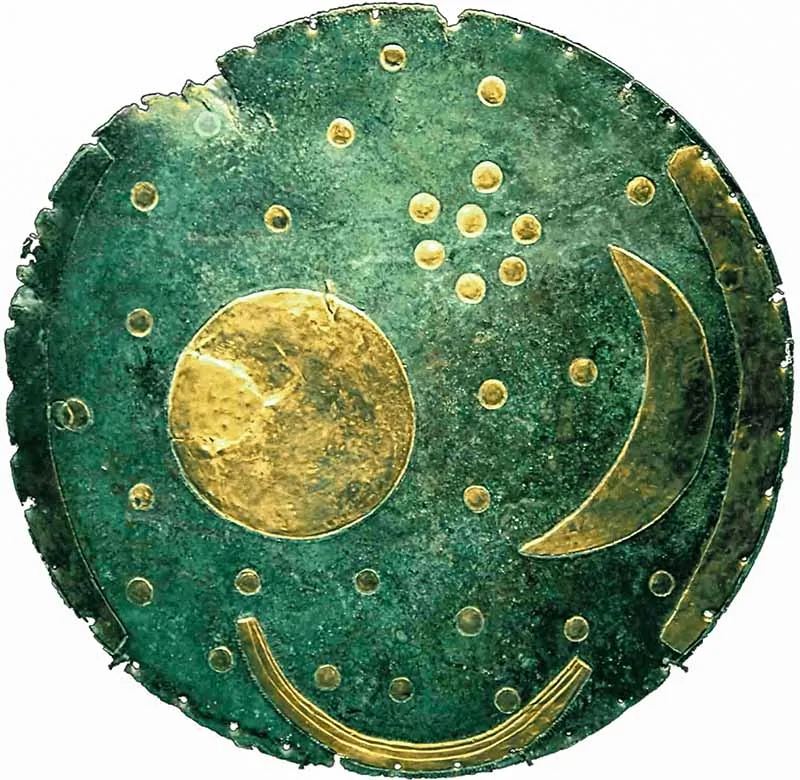 The Nebra sky disk;
(CC BY-SA 4.0 by Dbachmann).
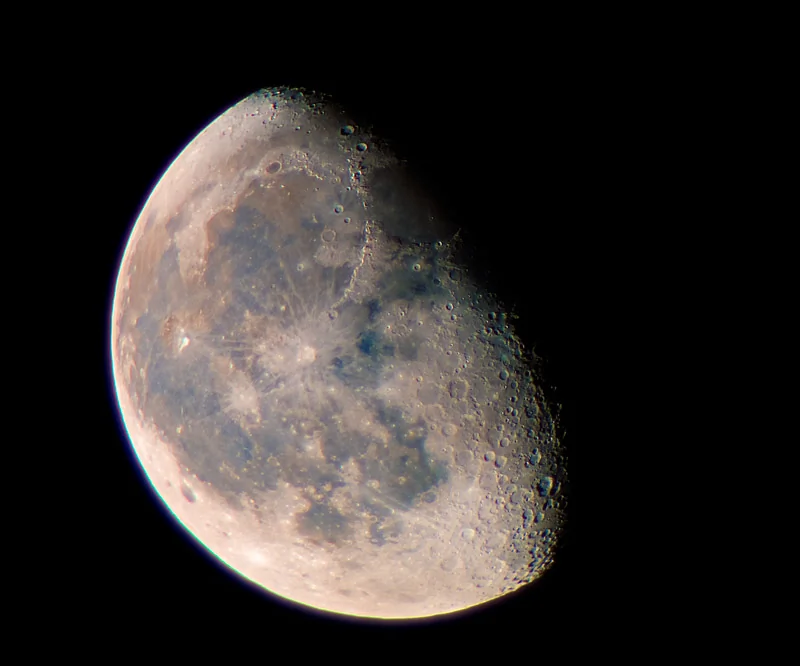 This is roughly how Giovanni Riccioli will have seen the Moon, with visible mountains, craters and, as he mistakenly believed, seas.
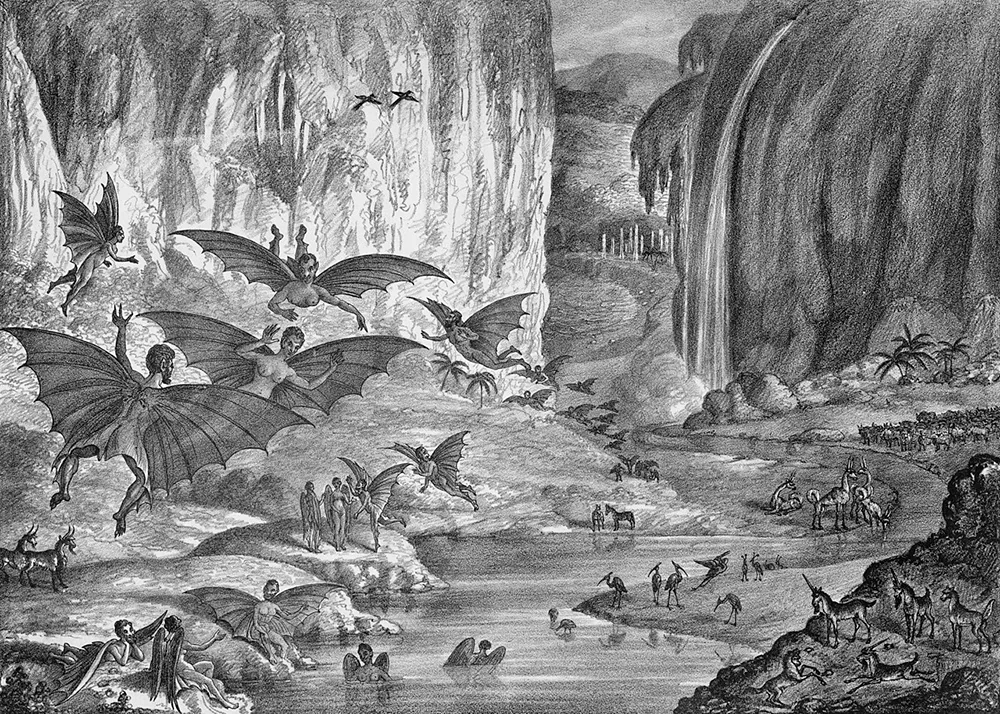 The illustration of an article of the "Great Moon Hoax" shows alleged life on the Moon.
The search for life in space began with our nearest cosmic neighbor, the Moon. Even when the first humans hunted in the steppes of Africa, the Moon gave them light at night and a reliable means of measuring time. The oldest known calendars are lunar calendars, which are based on the observable phases of the Moon.
Early depictions of the Moon can be found on the seal of Khashkhamer, the king of Ur (2100 BCE), or on the Nebra sky disk (1600 BCE). The Moon found its way into myths and legends, but it would elude close observation for thousands of years to come. That changed when a new era of astronomy dawned with the invention of the telescope in the early 17th century.
Among the first astronomers to observe the Moon was the Italian Giovanni Riccioli. Among other things, he described the highlands of the Moon as well as what he took to be seas. Seen through the simple telescopes of his time, the Moon appeared to be very similar to Earth: with mountains, highlands and seas. So it should come as no surprise that in 1638 the English bishop John Wilkins believed that the Moon, too, was inhabited. At least that is how he described it in his work [2]:
"The discovery of a vvorld in the moone, or, A discourse tending to prove that 'tis probable there may be another habitable world in that planet."
The scientific debate about life on the Moon had begun. The astronomer William Herschel (1738-1822), a first-rate astronomer of his time and discoverer of the planet Uranus, believed throughout his life that all planets, the Moon and even the Sun were inhabited. Herschel's son, the astronomer John Herschel, also believed he had observed cities on the Moon in 1778 [1]. But observing techniques developed quickly, and as early as the 1830s it was realized that no complex life existed on the Moon. At least none that produced cities, roads or canals.
Scientific findings, however, did not stop the newspaper "New York Sun" from publishing entirely fictitious reports about alleged discoveries by John Herschel on six consecutive days in August 1835, thereby triggering the so-called "Great Moon Hoax".
The astonished newspaper reader could read stories of bison, goats and unicorns on the Moon and learned that the Moon people lived in landscapes with trees, seas and beaches, had bat wings and built temples. As absurd as the stories were, it was an event that the then 7-year-old Jules Verne surely heard about, and perhaps it impressed him so much that he would later write the novel "From the Earth to the Moon".
Today we know that the seas of the Moon are basalt plains, that its surface is sterilized by the UV radiation of the Sun and that there is no atmosphere to provide oxygen. The Moon civilization dissolved in the light of knowledge. The matter was finally settled by the Apollo missions in the late 1960s. When their samples were examined for life in 1969, no evidence whatsoever of bacterial or microbial life forms was found.
It has become quiet on the Moon. A quiet that is only occasionally interrupted by a lander or a space probe, still searching for water, one of the basic requirements for life as we know it. If we find it, it is conceivable that one day it will be humans who bring permanent life to the Moon in research stations, just as we have brought it to the inhospitable regions of Antarctica.
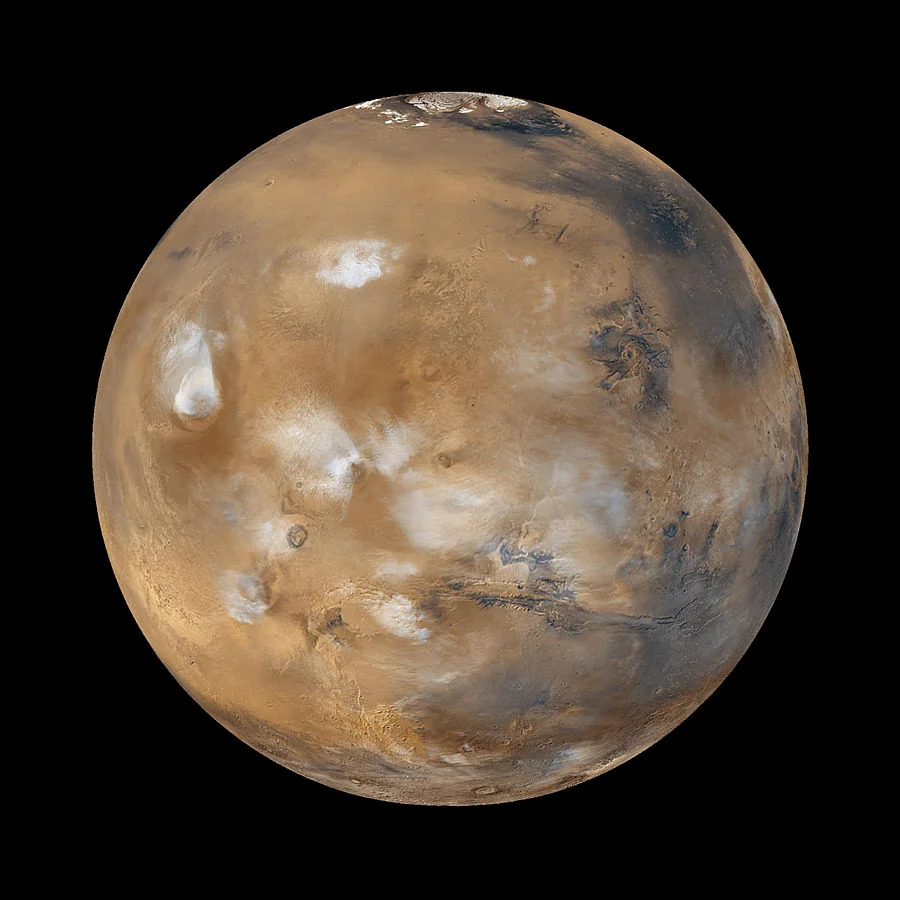 Mars, the Red Planet. (Source: NASA, via Wikimedia Commons)
After the Moon could be ruled out as the home of alien civilizations as early as the 19th century, attention turned to Mars. Mars, named by the Romans after the god of war because of its red color, is the fourth planet from the Sun in the Solar System. When it is visible in the night sky, its brightness lies between that of Jupiter and Saturn. Toward the outer Solar System it is our nearest neighbor, and at its closest it is only half as far away as the Sun.
Although it is the second-smallest planet in the Solar System, it is clearly visible from Earth. It is the only planet that can be recognized immediately by its color. Its surface is characterized by deep canyon systems, the largest volcanoes in the Solar System, desert regions, a multitude of impact craters and two polar caps.
In many respects it is the most Earth-like planet in the Solar System. At 24 hours, 38 minutes and 35.244 seconds, its day is only a little longer than a day on Earth. Due to its axial tilt of 25.19° it has seasons, and as on Earth, its polar caps grow in the Martian winter and melt in the Martian summer. Morning clouds of ice crystals appear in its thin atmosphere, and in the evening the Sun sinks below the horizon of a sandy desert landscape in a reddish shimmering sky. Observed only by the cameras of a few robots, the artificial ambassadors of the Blue Planet.
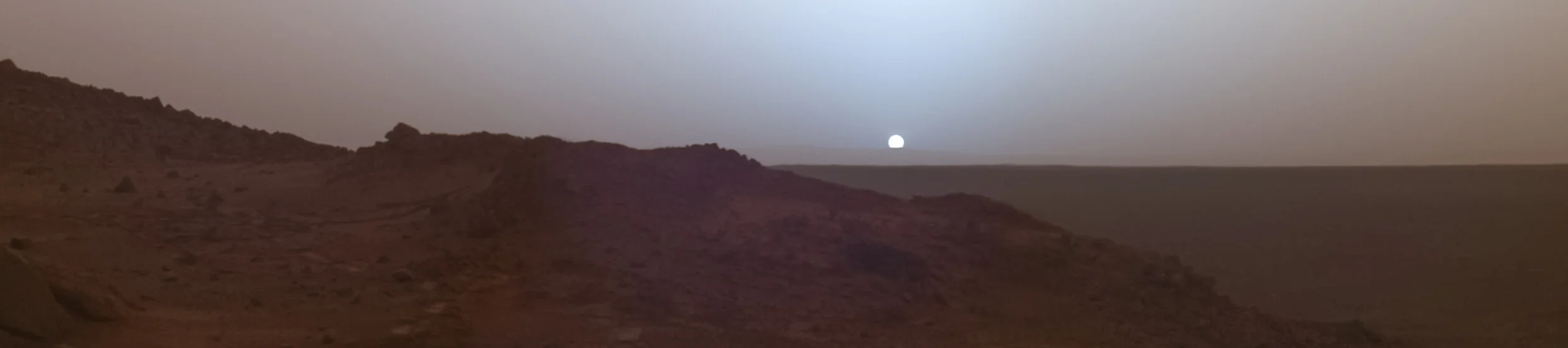 Sunset on Mars. (Source: NASA/JPL/Texas A&M/Cornell)
Before people spoke of "aliens" or "extraterrestrials", they knew the "Martians". No other planet stirred the imagination of so many science fiction authors in the 20th century. Beginning with "The War of the Worlds" by H.G. Wells (1898), a novel whose radio adaptation by Orson Welles in 1938 is said to have caused a panic in the USA, through Ray Bradbury's "The Martian Chronicles" (1950) to Hollywood films such as "Mission to Mars" (2000). Mars and its hypothetical inhabitants shaped the science fiction of the first half of the 20th century and sparked an interest in our neighboring planet that has shown itself since 1960 in 59 Mars exploration missions by various space agencies. Always at the very top of the list of priorities was the search for life on the Red Planet and with it the answer to the question: are we alone in the universe?
In 1877, Mars came particularly close to Earth at 56 million kilometers. At that time, drawings were the only way to record astronomical observations. For this reason, the first known maps of Mars were drawn by hand. This required patience and an extraordinary gift for observation. The Italian astronomer Giovanni Schiaparelli, director of the Milan observatory, had both.
Schiaparelli observed Mars at the Milan observatory with a refracting telescope of 218 mm aperture and 3.15 m focal length (f/14.5) [7]. The names of many surface features of Mars still go back to his map today, for example the Hellas basin or the Argyre basin. But when people talk about Schiaparelli's map today, they rarely mention how astonishingly accurate it was, given his observing equipment. Today it is mainly remembered for another detail of the map: the canals of Mars.
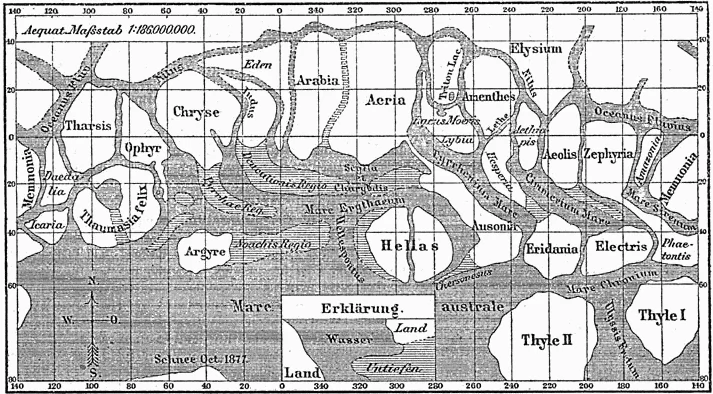 A map of Mars drawn by Giovanni Schiaparelli in 1877 shows seas, shallows, channels and land masses.
Schiaparelli believed he had seen naturally formed, straight depressions several hundred kilometers wide on Mars. In these shallow depressions, he suspected, water might flow. He called them "canali". Other astronomers, such as the American W. H. Pickering, later described similar surface details. What Schiaparelli could not foresee was that the term would be translated into English with the word "canal", a word that stands for artificially constructed waterways. The correct translation would have been the word "channel", which denotes a natural waterway.
The canals of Mars took on a life of their own. In the press, their discovery was immediately associated with artificial structures, and the idea of "Martians", indeed of an entire Martian civilization, was born. An idea that fascinated the American businessman Percival Lowell so much that he increasingly turned to astronomy. He would spend a large part of his life trying to prove the existence of the canals of Mars. In his mind, they were the desperate attempt of a technologically highly advanced Martian civilization to transport water from the polar caps to the equatorial regions of a planet that was drying out [8].
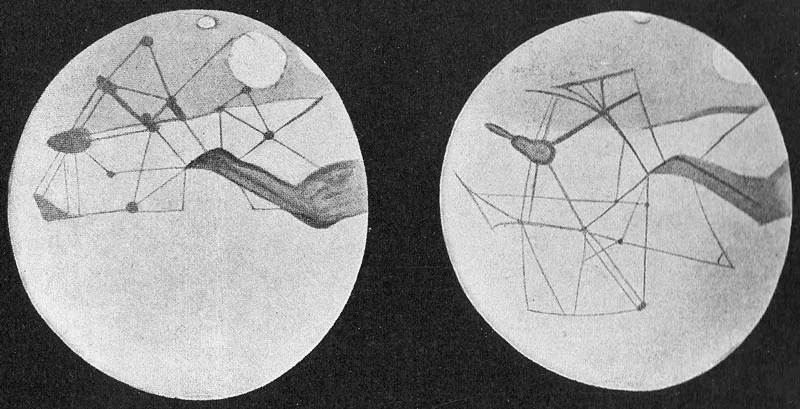 Canals of Mars in a drawing by Percival Lowell.
Lowell invested part of his considerable fortune and founded the observatory named after him in Flagstaff (Arizona). For the first time in the history of astronomy, an observatory was deliberately built in a sparsely populated area at high altitude in order to have optimal seeing conditions. In his well-equipped observatory, outstanding experts of his time would from then on work on the exploration of the planets of the Solar System. In the course of his work, Lowell himself published new maps of the canals of Mars, which were, however, met with ever greater skepticism.
The end of the idea of the Martian canals came slowly. In 1909, the Mount Wilson Observatory was opened. With its 1.5 m mirror it was the largest telescope of its time. It showed the canals described by Lowell more clearly and revealed them as geological structures that had presumably been formed by erosion. The last doubts that the canals did not exist were removed by a flyby of the Mariner 4 space probe at Mars in 1965.
In the end, it was a combination of optical illusions, misinterpretations, the limited technical possibilities of the time and perhaps also the wish for them to exist that brought forth the canals of Mars. But in trying to confirm the discovery, Percival Lowell set new standards for the construction of observatories and created conditions that would later lead to the discovery of the dwarf planet Pluto at the observatory named after him.
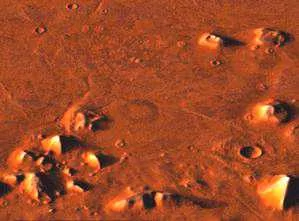 Overview image of the Cydonia region with the "Face on Mars" and "pyramids"
Shortly after it had become finally certain in the 1960s that the canals of Mars had their origin in the optical illusions of imperfect observing technology, NASA's Viking space probes set out for the Red Planet. Like the observatories of Schiaparelli and Lowell 100 years earlier, the probes were equipped with state-of-the-art observing instruments, and once again the debate about a past Martian civilization was immediately given new fuel.
The "Face on Mars" is a structure in the Cydonia region of the planet that was photographed on July 25, 1976, by the Viking 1 spacecraft from a distance of 1873 km. In the comparatively blurry images, the structure resembles a face. The human brain, trained to recognize faces, sees in it a face half covered by shadow, with eyes, a nose and part of a mouth. Nearby, mountains that appear pyramid-shaped can be seen.
Among scientists, the majority view emerged that the face was an optical illusion and that the structure had been shaped by wind erosion. However, a 3D reconstruction by Mark J. Carlotto from 1988, based on light and shadow, did not want to rule out an artificial origin because of the low quality of the original images [5] and even saw indications of the possible existence of a second eye socket and of teeth.
The true nature of the structure would occupy the imagination of countless authors for a quarter of a century. The Face on Mars found its way into the pop culture of the 20th century, among other things in the computer game "Zak McKracken and the Alien Mindbenders" (1988) and in the film "Mission to Mars" (2000). Authors speculated about a long-gone Martian civilization that wanted to draw attention to itself with gigantic monuments [4].
The Face on Mars in 1976 and 2006A final clarification had to wait until 2001. In 1996, NASA launched the Mars Global Surveyor spacecraft, whose goal was to map the entire planet. After the completion of the primary mission in January 2001, the "Face on Mars" was one of the first objects to be photographed (PIA03225: Highest-Resolution View of "Face on Mars"). The new images, now in impressive quality, showed a mountain, symmetrically shaped and worn smooth by the erosion of violent sandstorms. The "pyramids" nearby were also demystified by the high-resolution cameras of the Mars orbiter. What remained was a group of mountains and hills, unusual in shape but not extraordinarily so.
The Face on Mars paled in comparison to other, more spectacular images of the Red Planet. But these would not be the last images of the Cydonia region. It almost seems as if every further Mars probe has to take another look at the region that fired the imagination for so long. "2001 Mars Odyssey" (NASA; 2001), "Mars Express" (ESA; 2003) and the "Mars Reconnaissance Orbiter" (NASA; 2005) followed. They will not have been the last probes, and when the angle is right and you look very closely, it seems as if the face is still gazing into the sky, waiting.
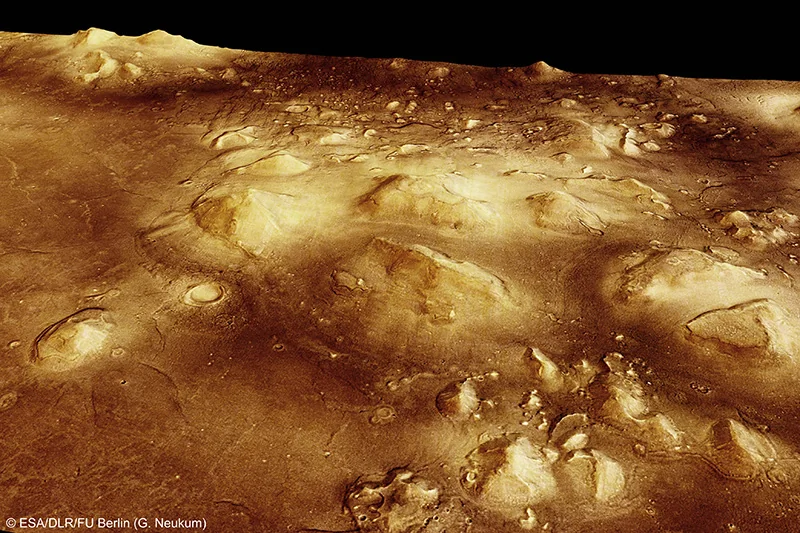 The "pyramids" of the Cydonia region, 3D reconstruction from Mars Express data (2006; ESA/DLR/FU Berlin (G. Neukum), CC BY-SA 3.0 IGO )
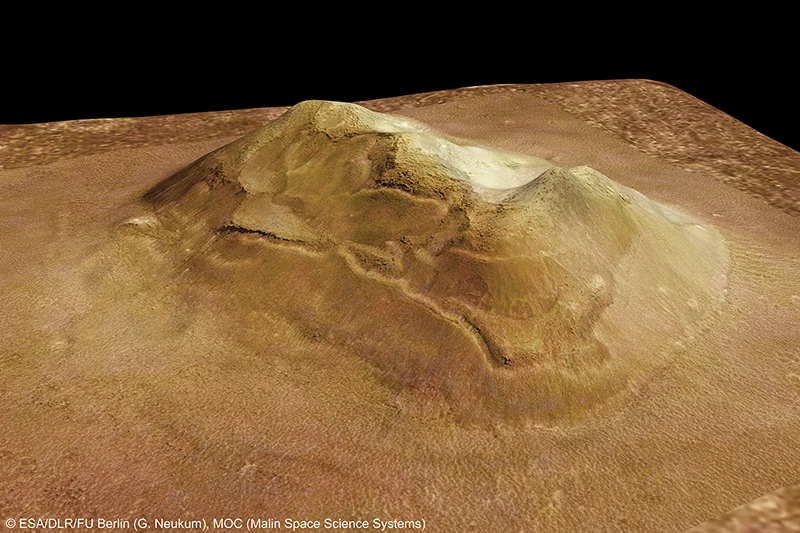 "Face on Mars", 3D reconstruction from Mars Express data (2006; ESA/DLR/FU Berlin (G. Neukum), CC BY-SA 3.0 IGO )
From today's perspective, the question of life beyond Earth is studied within astrobiology – an interdisciplinary branch of science that deals with the conditions for life in the universe. Both the Moon and Mars are considered largely hostile to life. Nevertheless, they provide important insights into how life could arise – or whether there might be traces of past life in the Solar System after all, for instance on Mars or beneath the ice crusts of some of Jupiter's moons.

Where is the second Earth? About the methods and the current state of exoplanet discovery.
How "Terra-X" a documentary format by german public service broadcaster ZDF failed at flat earth debunking.

Of Moon and Mars civilizations. About the historical beginnings of the search for life in space.
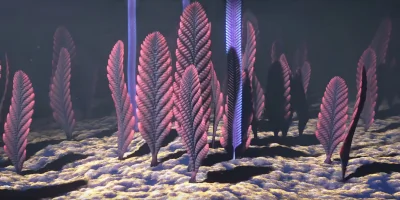
Visit the miraculous world of pre cambrian life forms. The Ediacara biota is a group of mostly soft-bodied organisms that lived during the Ediacaran period 635-538 million years ago.