Visit the miraculous world of pre cambrian life forms. The Ediacara biota is a group of mostly soft-bodied organisms that lived during the Ediacaran period 635-538 million years ago.

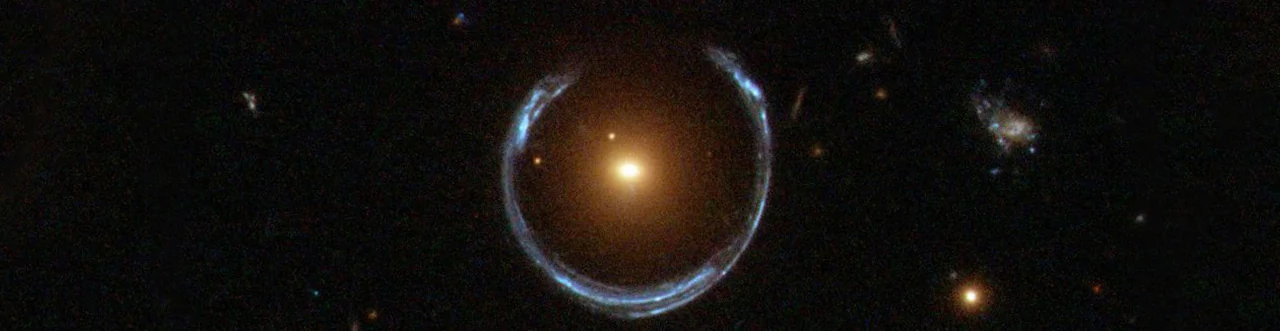 Horseshoe-shaped Einstein ring, imaged by the Hubble Space Telescope; Credit: ESA/Hubble & NASA
Microlensing is an astronomical phenomenon caused by the gravitational lensing effect. A gravitational lens is a mass or mass distribution (e.g. a black hole or a galaxy) located between a very distant light source and an observer. Owing to the curvature of space postulated by Einstein's theory of relativity, such a mass distribution slightly deflects light that passes close by. The result are ring-shaped structures like the one in the image above, or multiple images of objects lying very far behind the gravitational lens (see the Einstein Cross in the image below).
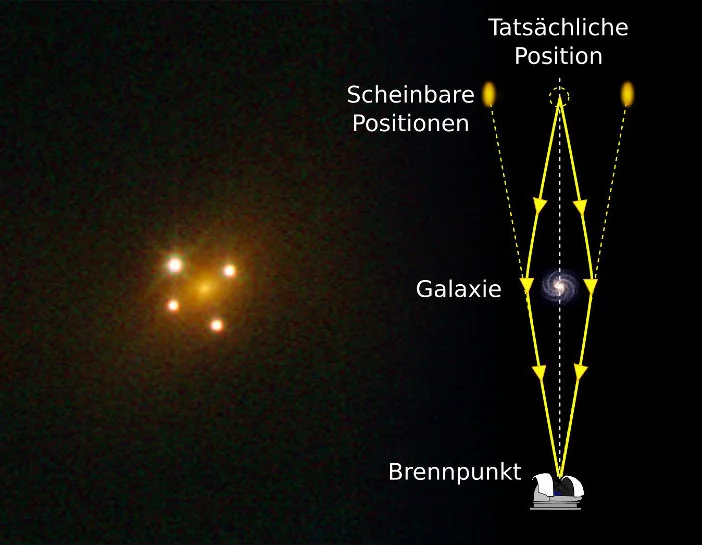 The Einstein Cross is a structure in the sky in which the light of a very distant
quasar is deflected by a galaxy in the foreground in such a way
that four images of the quasar arranged in the shape of a cross are created. (The quasar lies exactly
in line with the lensing galaxy and Earth.) Labels: "Tatsächliche Position" = actual position,
"Scheinbare Positionen" = apparent positions, "Galaxie" = galaxy, "Brennpunkt" = focal point.
In microlensing, the image produced by the gravitational lens is so small that it cannot be resolved with telescopes. Instead, only a short-lived increase in brightness is observed. If the gravitational lens and the background object pass very close to each other during such an event, the brightness curve has a characteristic shape. Because microlensing events are rare, observations are often made in the direction of the galactic center, where the density of stars is higher and such events can therefore be observed more frequently.
Applied to the search for exoplanets this means: when a distant star passes behind a planetary system, the gravitational lensing effect can increase the observable brightness of the star. The brightness curve then looks similar to a bell curve. If the star acting as a gravitational lens has planets, gravitational lensing can occur at the planets as well, which briefly changes the brightness curve significantly. This effect lasts about a day and causes two sharp brightness peaks a few days apart.
One advantage of searching for exoplanets with microlensing events is that they are suitable for discovering planets that are far away from their host star and have a comparatively low mass (several Earth masses). Exoplanets can thus be discovered that remain invisible to other methods.
The disadvantage of microlensing events is that they are extremely rare and do not repeat for a given combination of exoplanetary system and background star. The probability that a star causes a microlensing event at any given time is 10^-6. To increase the chance of capturing such an event, millions of stars are observed simultaneously.
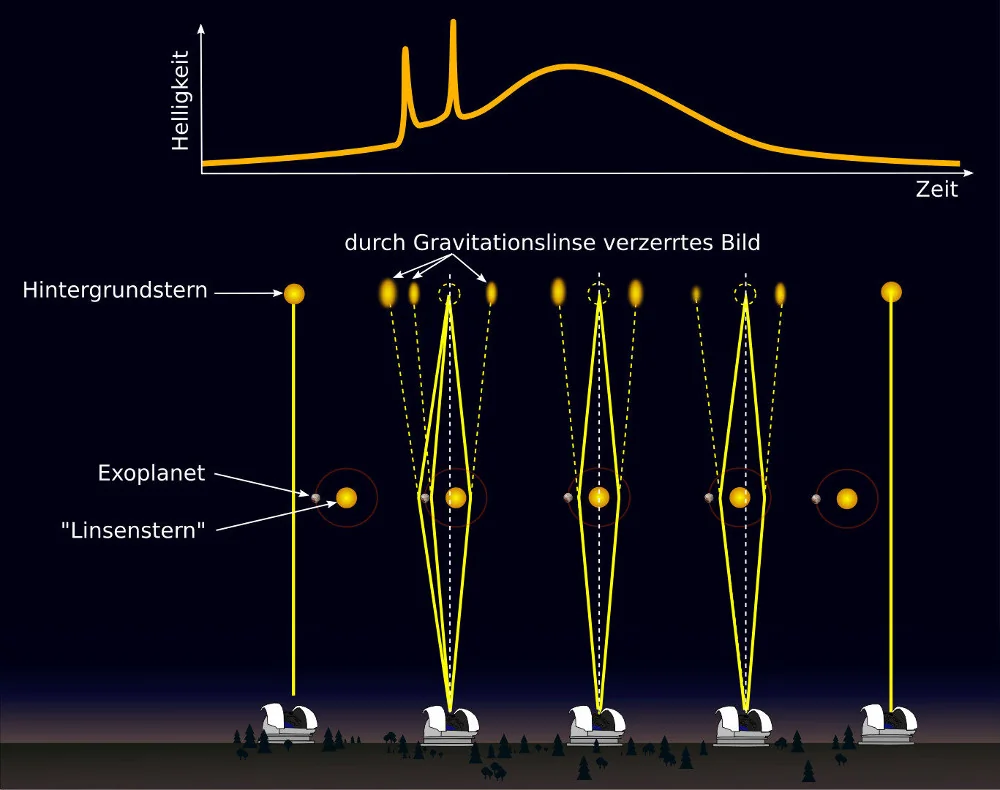 Microlensing by the exoplanet causes a brief increase in the
measured brightness during a gravitational lensing event. Labels: "Helligkeit" = brightness, "Zeit" = time,
"Hintergrundstern" = background star, "Linsenstern" = lens star,
"durch Gravitationslinse verzerrtes Bild" = image distorted by the gravitational lens.
The following animation shows an artist's impression of a microlensing event at an exoplanet. The event is characterized by a sharp rise in the measured total brightness of the planetary system.
Illustration of a microlensing event at an exoplanetary system. (Source: NASA's Goddard Space Flight Center Conceptual Image Lab; Walt Feimer, Scott Wiessinger, Neil Gehrels) Summary:
Visit the miraculous world of pre cambrian life forms. The Ediacara biota is a group of mostly soft-bodied organisms that lived during the Ediacaran period 635-538 million years ago.
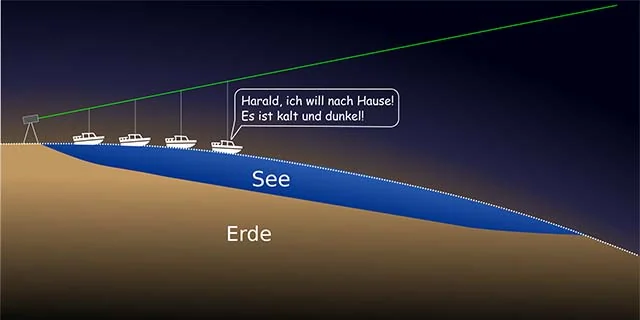
How "Terra-X" a documentary format by german public service broadcaster ZDF failed at flat earth debunking.

Where is the second Earth? About the methods and the current state of exoplanet discovery.
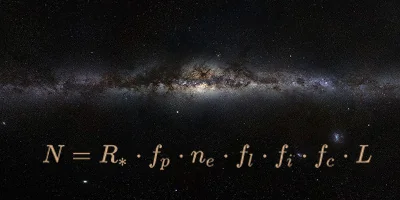
How many technological civilizations exist in the Milky Way? What the origin of life on Earth tell us about the parameters of the Drake equation.