Visit the miraculous world of pre cambrian life forms. The Ediacara biota is a group of mostly soft-bodied organisms that lived during the Ediacaran period 635-538 million years ago.

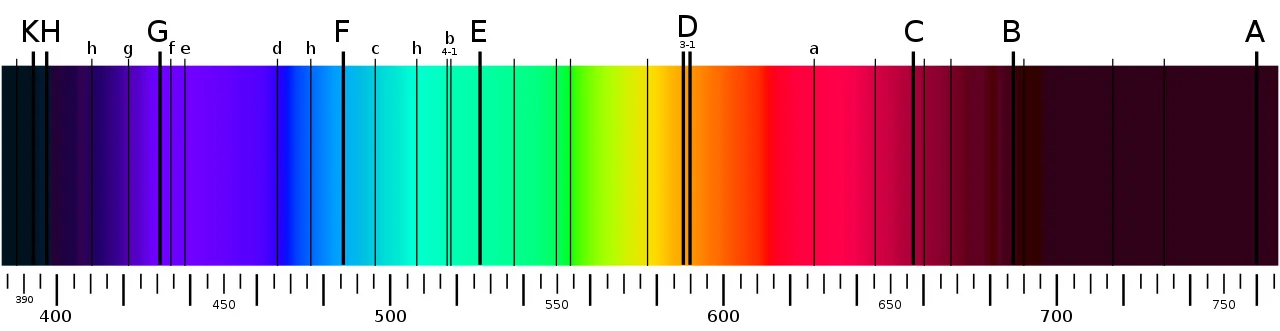 Fraunhofer lines - absorption lines in the spectrum of the Sun. (Image credit: Wikimedia Commons)
If you split the light of the Sun into its colored components by wavelength, you get a color spectrum. Like a rainbow, this spectrum contains all visible colors. In 1802, the English chemist William Hyde Wollaston was the first to discover dark lines in the spectrum of the Sun [1]. A few years later, in 1814, the German physicist Joseph von Fraunhofer independently made the same discovery and began to study the lines systematically. He succeeded in finding a total of 570 lines and in determining their positions precisely.
45 years later (1859), the physicist Gustav Kirchhoff and the chemist Robert Bunsen realized that some of the observable lines matched known emission lines from the spectra of glowing gases. From this it was concluded that the dark lines in the solar spectrum are caused by absorption processes involving the same chemical elements. For this reason, such lines in a spectrum are today called absorption lines.
A physical method had been discovered that made it possible to investigate the composition of stars by analyzing the light they emit. A new branch of astronomy, astronomical spectroscopy, was born. As early as 1868, studies of the solar spectrum provided evidence of the then still unknown element helium. The spectroscopic investigation of stars and nebulae began. It would, however, take more than another 100 years until spectroscopy had become precise enough to study the extremely small effects caused by exoplanets.
The radial velocity method, also called Doppler spectroscopy, was the first and remains one of the most successful methods of exoplanet detection. It is based on the fact that in a planetary system the planet and the star orbit a common center of mass. Massive exoplanets in particular have a measurable influence on the motion of their host stars. The effect is small, because the mass of the star exceeds the mass of the exoplanet by orders of magnitude, but a slight variation in the radial velocity of the star can nevertheless be detected if one or more massive exoplanets are present.
The Doppler effect, illustrated by a moving star. The frequency of the light emitted in the direction of motion is shifted toward blue, the frequency of the light emitted against the direction of motion is shifted toward red. [2]To detect a planet, high-resolution spectra of the star are recorded in quick succession. Because of the wobbling motion of the star, the Doppler effect causes a slight shift in the stellar spectrum. If the star moves toward Earth, the spectrum is shifted toward blue. If the star moves away from Earth, it is shifted toward red. From the periodicity of this shift, the existence and orbital parameters of a possible companion can be inferred.
Star and planet orbit a common center of mass (barycenter). The motion of the star leads to a slight change in color caused by the Doppler shift in the stellar spectrum. [1]The method works best when the planetary system is seen edge-on. Stars with planetary systems that are observed face-on show no observable Doppler shift. In most cases a planetary system is seen neither edge-on nor face-on. In these cases, Doppler spectroscopy only records the part of the radial velocity that points toward Earth. A mass estimate based on these data therefore only yields a minimum value for the mass of the planet.
Summary:
Visit the miraculous world of pre cambrian life forms. The Ediacara biota is a group of mostly soft-bodied organisms that lived during the Ediacaran period 635-538 million years ago.
How "Terra-X" a documentary format by german public service broadcaster ZDF failed at flat earth debunking.

Of Moon and Mars civilizations. About the historical beginnings of the search for life in space.

Where is the second Earth? About the methods and the current state of exoplanet discovery.