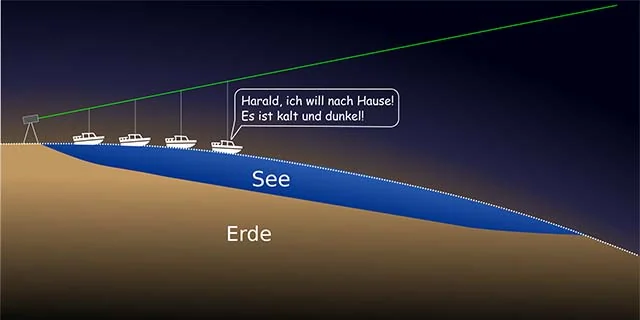
How "Terra-X" a documentary format by german public service broadcaster ZDF failed at flat earth debunking.

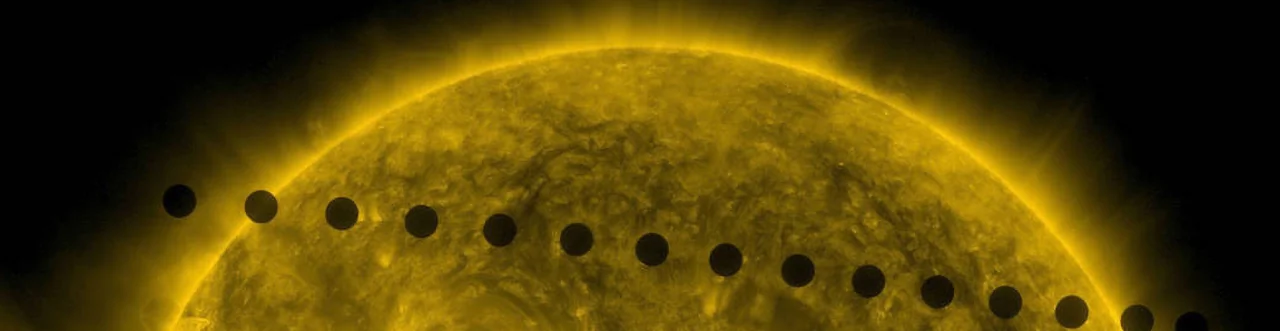 Transit of Venus in 2012. (Image credit: NASA/SDO, AIA)
The transit method is a very successful method of exoplanet detection. A planetary transit is the passage of a planet between a star and Earth. In the Solar System, as seen from Earth, this is only possible for the inner planets Venus and Mercury. During a transit, the planet covers a small part of the star's disk and thus reduces the amount of visible light. This drop in energy can be measured with good telescopes even for far-away stars.
A transit event in the Solar System. The video does not show an exoplanet transit, however, but the transit of the Moon in front of the Sun. Recorded during the STEREO-B mission for the study of solar storms. (Source: NASA/STEREO Project)Because of the large distances, a direct observation of exoplanet transits is practically impossible. Even modern large telescopes can only optically resolve stars in exceptional cases. A planetary transit can only be measured indirectly, through a slight reduction in the star's brightness. The transit lasts only a few hours to days and is therefore short compared to the orbital period of the planet. This makes the time window for a detection very small. To be discovered, the planet has to pass exactly between its host star and Earth. Seen from Earth, the exoplanetary system therefore has to be viewed edge-on. That is unlikely, but by observing a very large number of stars at the same time with space telescopes, the probability of observing exoplanet transit events can be increased considerably. The Kepler space telescope, for example, was able to record thousands of these events between 2009 and 2018.
The animation shows how transits of exoplanets lead to a minimal change in the brightness of their star. (Source code)The transit method is particularly well suited for estimating the radius of the exoplanet. (Source code) The following formula applies approximately:
Here \(R_p\) and \(R_*\) are the radii of the exoplanet and the star. \(F\) is the undisturbed light flux of the star and \(\Delta F\) represents the reduction of the light flux caused by the exoplanet.
Summary:The transit method also offers ways to discover exomoons. This is, however, far more difficult than discovering exoplanets and currently still at the limit of what is technically possible. Despite all difficulties, the number of reported exomoon candidates keeps growing. A first confirmed discovery is still pending, though.
An exomoon is gravitationally bound to its planet. Planet and moon move around their common center of mass. The moon's influence on the motion of the planet causes the planet to enter successive transits a little earlier or later each time. These variations in time are measurable in theory. One difficulty, however, is that similar variations can also be caused by exoplanets that have not been discovered yet.
In the presence of a moon, the duration of the planetary transit varies slightly depending on the moon's position. This is because the planet, being bound to its exomoon, passes its star a little faster or slower. Repeated measurements of the transit duration can thus reveal a possible companion of the exoplanet.
An exomoon accompanying the planet will also cause a small drop in brightness during a transit. The transit curve of the moon is then superimposed on that of the planet. The effect of the moon is much smaller than that of the planet, but for large moons it can already exceed the detection threshold. If a transit is observed several times, the moon will enter the transit sometimes a little earlier and sometimes a little later, depending on its position on its orbit, and will thus slightly change the transit curve.
Space telescopes can work independently of day and night, and their observations are not impaired by Earth's atmosphere. For this reason they are an ideal platform for the search for exoplanets.
The first attempt to discover exoplanets with a space telescope was made by the French space agency CNES in 2006 with the COROT space telescope. During the mission, a small number of 10 stars at a time were observed over a period of 150 days with high-precision instruments, and their brightness variations were recorded (at 0.1 - 10 Hz). The data were meant to provide information about the size of the thermonuclear active stellar core, the helium content, the thickness of the convection layers and the rotation of the stars.
Another part of the mission was the search for exoplanets using the transit method. For this purpose, 12,000 stars were monitored simultaneously (180,000 in total). The monitored stars were mostly of spectral classes K and M with apparent magnitudes from 12 mag to 15.5 mag. The mission was expected to discover hundreds of Jupiter-sized exoplanets and 30-40 Earth-like planets. In fact, however, COROT discovered only 32 exoplanets.
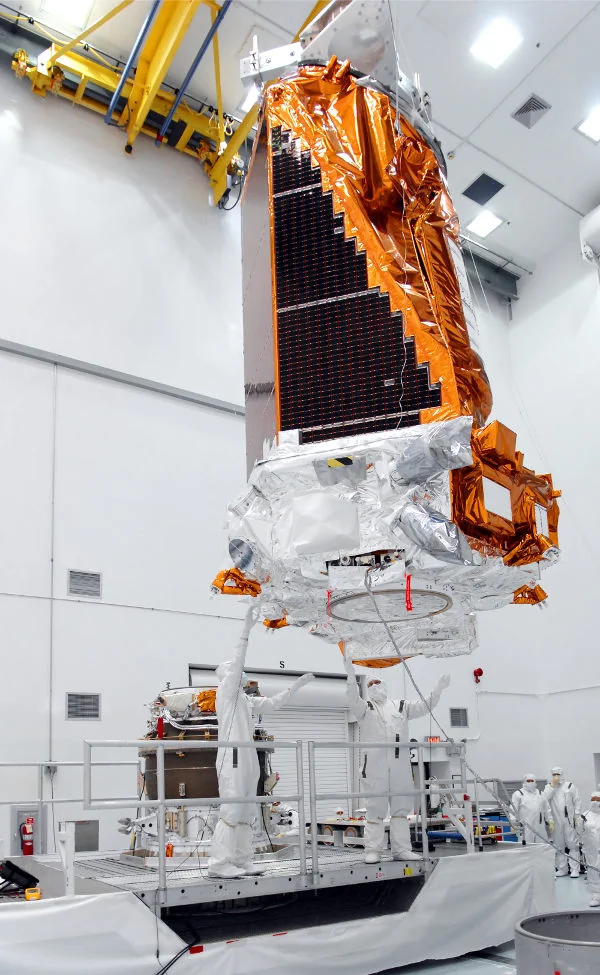 The Kepler space telescope.
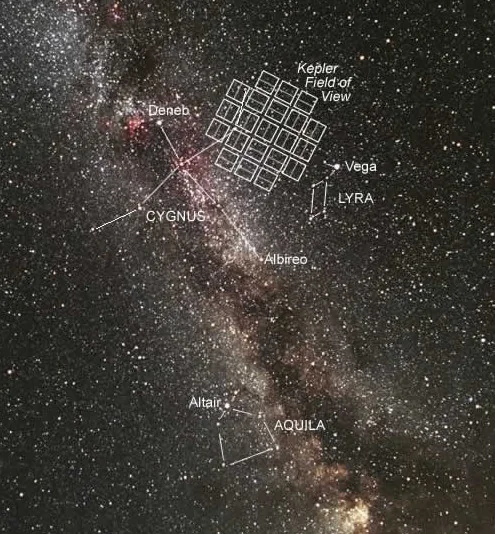 The target area of the Kepler mission in the constellation Cygnus.
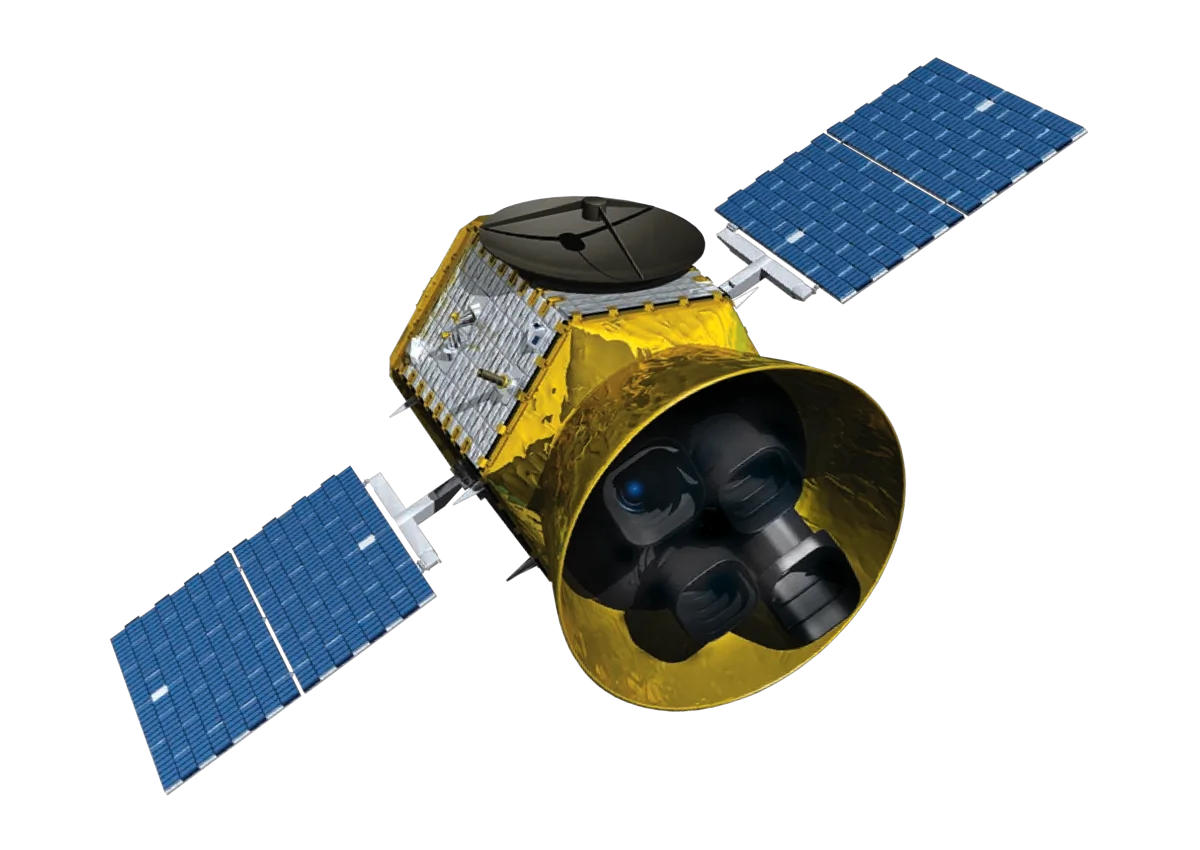 Artist's impression of the TESS space telescope. (Source: NASA via Wikimedia Commons)
In March 2009, NASA launched the Kepler mission, whose declared goal was the discovery of Earth-sized exoplanets in the habitable zone around Sun-like stars. It was hoped that this would allow an estimate of the parameter \(n_e\) of the Drake equation. The mission was originally designed for 3.5 years but was extended to more than 8 years.
To minimize the disturbing influence of Earth on the observations, the space telescope was not placed in an orbit around Earth but in one around the Sun. It trailed behind Earth and circled the Sun in 372.5 days, somewhat more slowly than Earth itself.
The only scientific instrument on board was a photometer for the simultaneous brightness measurement of about 150,000 stars in the constellation Cygnus. Of these, about 90,000 were so-called main-sequence stars, essentially Sun-like stars of spectral type G. The maximum sensitivity of Kepler's instruments was in the range of 400 - 865 nm wavelength and was thus optimized for the observation of these stars. To obtain transit data that were as accurate as possible, Kepler measured the brightness of the stars at intervals of about 30 minutes.
Kepler's primary mission was ended on August 15, 2013, following the failure of two reaction wheels. A modified mission continued to search for exoplanets until 2018. On October 30, 2018, science operations were stopped because the spacecraft had run out of fuel. Shortly afterward, on November 15, 2018, the telescope was switched off completely.
The Kepler mission was exceptionally successful at discovering new exoplanets and an important step on the way to the search for life on other planets. Kepler's main task was to find promising Earth-like exoplanets, which were then to be examined more closely in follow-up missions. This did not succeed to the extent hoped for. Before the start of the mission, the discovery of up to 50 Earth-like exoplanets was expected, under the assumption that on average every star has one Earth-sized planet. Here, an exoplanet was defined as Earth-like if it had between 0.9 and 1.2 times the size of Earth and was located at a distance of 0.8 to 1.2 AU from its star. (1 AU corresponds to the distance between Earth and the Sun)
In this range of sizes and distances, Kepler found only three candidates instead of the hoped-for 40-50 (KOI-5499.01, KOI-7179.01 and KOI-7235.01). All of them are unconfirmed so far (as of January 2022) and, in terms of signal strength, lie at the limit of what Kepler's instruments were able to detect. The data are too noisy. It is possible that none of the three Earth-like exoplanets will ever be confirmed.
One possible explanation for the lack of more discoveries is that the brightness of the average Sun-like star fluctuates more strongly than originally assumed on the basis of solar activity. That could mean that the Sun is an unusually quiet star. Another possibility would be that Earth-like exoplanets are rarer than originally assumed. It will be up to future missions to answer these questions. (based on [2])
TESS, the Transiting Exoplanet Survey Satellite, is a NASA space telescope that was launched on April 18, 2018. Like the Kepler space telescope before it, it observes exoplanet transits. In contrast to Kepler, it is designed to scan the entire sky with wide-angle cameras. Its field of observation is 400 times larger than Kepler's. The main focus of the mission (primary mission) is the search for small Earth-like exoplanets around bright stars near Earth.
TESS began science operations on July 25, 2018. The first published observation was the comet C/2018 N1. The first exoplanet discovery was that of a super-Earth in the Pi Mensae system, which was announced on September 18, 2018. By September 2019, TESS had identified 1000 "objects of interest", 29 of which had already been confirmed as exoplanets. 20 of these are smaller than 4 Earth radii.
On January 6, 2020, NASA announced the discovery of the planet TOI-700 d. It is the first Earth-sized planet that TESS discovered in the habitable zone of a star. It orbits its star, a red dwarf, once every 37.43 days. The planetary system TOI 700 is located about 100 light-years from Earth. Two further planets were also discovered in it: the Earth-sized TOI-700 b and TOI-700 c, a super-Earth.
In July 2020, TESS completed the data collection for the primary mission. By then, 66 confirmed exoplanets and more than 2000 exoplanet candidates had been discovered. The analysis of the data will take years.

How "Terra-X" a documentary format by german public service broadcaster ZDF failed at flat earth debunking.
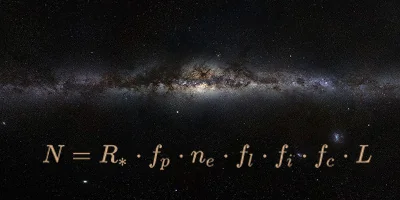
How many technological civilizations exist in the Milky Way? What the origin of life on Earth tell us about the parameters of the Drake equation.

Of Moon and Mars civilizations. About the historical beginnings of the search for life in space.

The story of the first 3.5 billion years of life on Earth. From chemical evolution through prokaryotes and photosynthesis to the first multicellular life forms.