Of Moon and Mars civilizations. About the historical beginnings of the search for life in space.

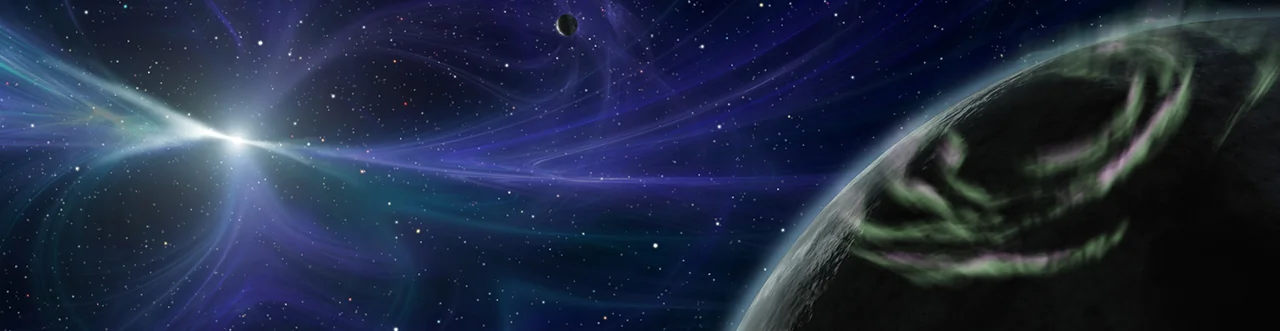 Artist's impression of the exoplanets around the pulsar PSR B1257+12. (Image credit: NASA/JPL-Caltech/R. Hurt)
One of the oldest methods of exoplanet detection is the pulsar timing method. It was used in 1992 by Aleksander Wolszczan and Dale Frail to discover the first confirmed exoplanets [2].
Pulsars are rapidly rotating neutron stars. They are stars in name only, because neutron stars are the extremely dense remnant of a star that has exploded in a supernova. They emit strong electromagnetic radiation along the axis of their magnetic field, which can differ from the axis of rotation. If Earth lies in the direction of the pulsar's magnetic field axis, pulsars can be perceived as periodically flashing sources of electromagnetic radiation.
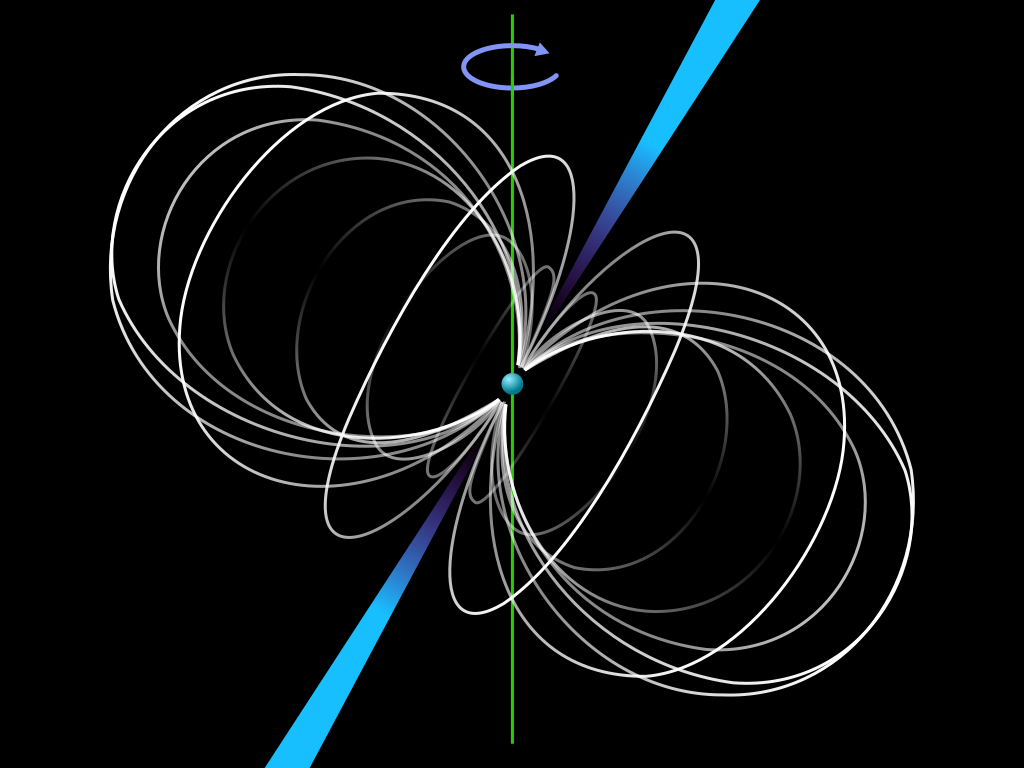 Schematic view of a pulsar. The axis of rotation differs from the axis of the magnetic field.
(CC-BY-SA Created by Wikipedia user
Mysid, based on en:Image:Pulsar schematic.jpg
by Roy Smits.)
Pulsars without a companion periodically emit the same radiation pattern over and over again. Their periodicity is more reliable than an atomic clock. If an exoplanet is present, there are periodic fluctuations in this pattern, because pulsar and exoplanet move around a common centre of mass. As a result of this motion, the received pulse sequence of the pulsar changes slightly and periodically.
Pulsar and planet orbit a common centre of mass (barycentre). The motion of the star leads to slight variations in time in the received pulse sequence. [3]Exoplanets orbiting pulsars could either have formed from the debris of the supernova or be the remains of a planetary system that already existed before the supernova. The radiation emitted by a pulsar and the fact that neutron stars give off very little heat make exoplanets orbiting pulsars unsuitable candidates for the search for life.
Summary:
Of Moon and Mars civilizations. About the historical beginnings of the search for life in space.

Where is the second Earth? About the methods and the current state of exoplanet discovery.

The story of the first 3.5 billion years of life on Earth. From chemical evolution through prokaryotes and photosynthesis to the first multicellular life forms.
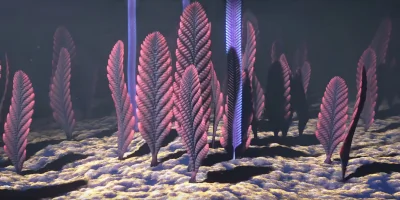
Visit the miraculous world of pre cambrian life forms. The Ediacara biota is a group of mostly soft-bodied organisms that lived during the Ediacaran period 635-538 million years ago.